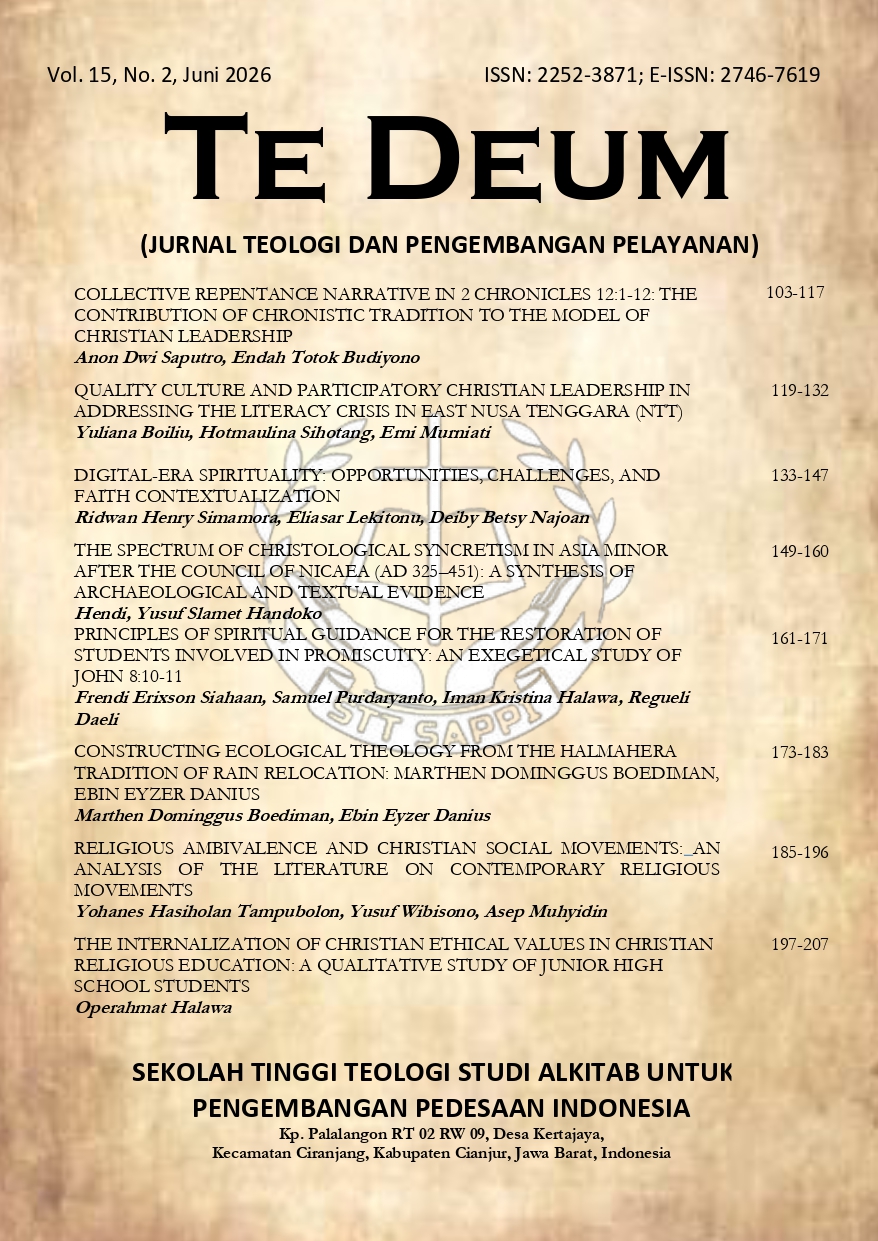
Collective Repentance Narrative in 2 Chronicles 12:1-12
The Contribution of Chronistic Tradition to the Model of Christian Leadership
Abstract
This study aims to reconstruct the narrative and theological dimensions of 2 Chronicles 12:1–12 and to examine their relevance for a Christian leadership paradigm. While previous scholarship has highlighted the pedagogical and theological functions of Chronicles, the theme of collective repentance and its implications for Christian leadership have received comparatively limited attention. This research employs a qualitative method utilizing narrative criticism. The findings reveal a consistent narrative-theological pattern: pride leads to downfall, prophetic rebuke prompts reflection, collective repentance invites divine mercy, and communal restoration becomes the ultimate goal. This pattern underscores that Christian leadership is grounded in humility, openness to prophetic correction, and responsibility toward the community. Based on these findings, the study proposes a Chronicler’s leadership model consisting of four key elements: responsible authority, openness to prophetic rebuke, collective repentance as a response to crisis, and communal restoration as the ultimate purpose of leadership.
Downloads
References
Ben Zvi, Ehud. History, Literature and Theology in the Book of Chronicles. 0 ed. Routledge, 2014. https://doi.org/10.4324/9781315711270.
Blackaby, Henry T., and Richard Blackaby. Spiritual Leadership: Moving People on to God’s Agenda. Broadman & Holman Publishers, 2001.
Brown, Francis, S. R. Driver, and Charles A. Briggs. The Brown-Driver-Briggs Hebrew and English Lexicon: With an Appendix Containing the Biblical Aramaic: Based on the Lexicon of Wilhelm Gesenius as Translated by Edward Robinson, and Edited with Constant Reference to the Thesaurus of Gesenius as Completed by E. Rödiger, and with Authorized Use of the German Editions of Gesenius’ Handwörterbuch Über Das Alte Testament. Edited by Francis Brown. Clarendon Press, 1907.
Conti, Marco, ed. 1-2 Kings, 1-2 Chronicles, Ezra, Nehemiah, Esther. 1[st printing in paperback]. Ancient Christian Commentary on Scripture. Old Testament 5. IVP Academic, 2019.
Geyser-Fouche, Ananda. “1 and 2 Chronicles as a Discourse of Power.” HTS Teologiese Studies / Theological Studies 79, no. 1 (2023). https://doi.org/10.4102/hts.v79i1.8011.
Hill, Andrew E., and John H. Walton. A Survey of the Old Testament. Fourth edition. Zondervan, 2023.
Holladay, William. A Concise Hebrew And Aramaic Lexicon Of The Old Testament. Brill, 2000.
Jonker, L.C. Defining All-Israel in Chronicles: Multi-Levelled Identity Negotiation in Late Persian-Period Yehud. Forschungen Zum Alten Testament. Mohr Siebeck, 2016. https://books.google.co.id/books?id=8ZgNY-5RgkMC.
Jonker, Louis. “Reforming History: The Hermeneutical Significance of the Books of Chronicles.” Vetus Testamentum 57, no. 1 (2007): 21–44. https://doi.org/10.1163/156853307X167846.
Leithart, P.J., R.R. Reno, R. Jenson, et al. 1 & 2 Chronicles (Brazos Theological Commentary on the Bible). Brazos Theological Commentary on the Bible. Baker Publishing Group, 2019. https://books.google.co.id/books?id=rpGGDwAAQBAJ.
Marfo, Elisha Kwabena. “The Interplay of Leadership Styles and Qualities: A Narrative Analysis of 2 Chronicles 32:1-23.” Asia-Africa Journal of Mission and Ministry 16 (August 2017): 81–100. https://doi.org/10.21806/aamm.2017.16.05.
Pratt, R.L., and H.M. Notoprodjo. Ia Berikan Kita Kisah-Nya: Panduan Bagi Siswa Alkitab Untuk Menafsirkan Narasi Perjanjian Lama. Momentum, 2005. https://books.google.co.id/books?id=L7U-yQEACAAJ.
Sanders, J Oswald. Spiritual Leadership: Principles of Excellence for Every Believer. Moody Publishers, 2017.
Selman, M.J. 2 Chronicles: A Commentary. Tyndale Old Testament Commentaries. InterVarsity Press, 1994. https://books.google.co.id/books?id=N78CQAAACAAJ.
Waltke, Bruce K. An Old Testament Theology: An Exegetical Canonical and Thematic Approach. Zondervan, 2007.
Williams, Ronald J., and John C. Beckman. Williams’ Hebrew Syntax. 3rd ed. University of Toronto Press, 2007.
Zvi, Ehud Ben. “The Book of Chronicles: Another Look.” Studies in Religion/Sciences Religieuses 31, nos. 3–4 (2002): 261–81. https://doi.org/10.1177/000842980203100301.
Copyright (c) 2026 Te Deum (Jurnal Teologi dan Pengembangan Pelayanan)

This work is licensed under a Creative Commons Attribution 4.0 International License.
Examples of Creative Commons Licensing Notifications in the Copyright Notices
1. Proposed Policy for Journals That Offer Open Access
Authors who publish with this journal agree to the following terms:
- Authors retain copyright and grant the journal right of first publication with the work simultaneously licensed under a Creative Commons Attribution License that allows others to share the work with an acknowledgement of the work's authorship and initial publication in this journal.
- Authors are able to enter into separate, additional contractual arrangements for the non-exclusive distribution of the journal's published version of the work (e.g., post it to an institutional repository or publish it in a book), with an acknowledgement of its initial publication in this journal.
- Authors are permitted and encouraged to post their work online (e.g., in institutional repositories or on their website) prior to and during the submission process, as it can lead to productive exchanges, as well as earlier and greater citation of published work (See The Effect of Open Access).
2. Proposed Policy for Journals That Offer Delayed Open Access
Authors who publish with this journal agree to the following terms:
- Authors retain copyright and grant the journal right of first publication, with the work [SPECIFY PERIOD OF TIME] after publication simultaneously licensed under a Creative Commons Attribution License that allows others to share the work with an acknowledgement of the work's authorship and initial publication in this journal.
- Authors are able to enter into separate, additional contractual arrangements for the non-exclusive distribution of the journal's published version of the work (e.g., post it to an institutional repository or publish it in a book), with an acknowledgement of its initial publication in this journal.
- Authors are permitted and encouraged to post their work online (e.g., in institutional repositories or on their website) prior to and during the submission process, as it can lead to productive exchanges, as well as earlier and greater citation of published work (See The Effect of Open Access).