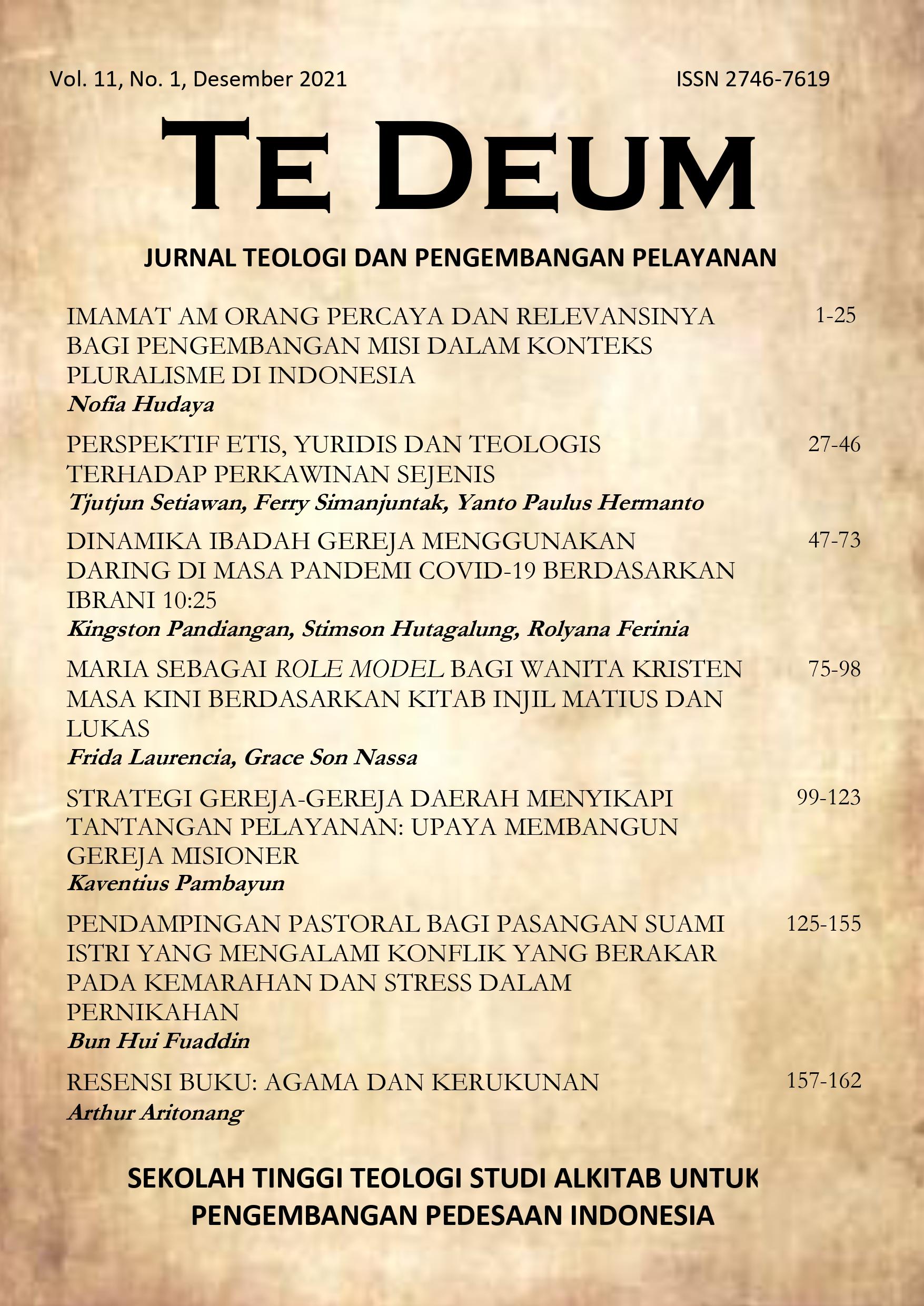
Pendampingan pastoral bagi pasangan suami istri yang mengalami konflik yang berakar pada kemarahan dan stress dalam pernikahan
Abstract
This article is a literature study that describes the concept of pastoral care for married couples who experience conflict in marriage. To explain this, the author presents various information from primary sources in the form of interviews with married couples who experience conflict in marriage. The author also presents information from secondary sources related to the research topic which is then described descriptively. From the research conducted, the author found that the conflict experienced by the husband was rooted in anger and stress. Married couples who experience anger and stress in marriage need pastoral assistance in dealing with situations in their married life, because it is not easy to resolve these two things well and healthily. Pastoral counseling to deal with married couples who experience anger and stress in marriage needs to be given since premarital counseling.
Downloads
References
Abineno, J. L. Ch. Sekitar Etika Dan Soal-Soal Etis. Jakarta: BPK Gunung Mulia, 1994.
Abineno, JLCh. Tafsiran Kitab Efesus. Jakarta: BPK Gunung Mulia, 1992.
Anderson, Neil T. Restoring Broken Relationship : The Path to Peace And. Minnesota: Bethany House Publishers, 2008.
Balswick, Jack O, and Judith K. “The Family : A Christian Perspective On The Contemporary Home.” Baker Book, 2014.
Clebsch, William A., and Charles R. Jaekle. Pastoral Care in Historical Perspective. New York: Harper & Row, 1967.
Clinebell, Howard. Tipe-Tipe Dasar Pendampingan Dan Konseling Pastoral. Yogyakarta: Kanisius dan BPK Gunung Mulia, 2002.
DiGiuseppe, Raymond, and Raymond Chip Tafrate. Understanding Anger. USA: Oxford University Press, 2007.
Eggerichs, Emerson. “Love & Respect : The Love She Most Desires, The Respect He Desperately Needs.” Nashville: Thomas Nelson Inc, 2004.
Faupel, Adrian, Elizabeth Herrick, and Peter Sharp. Anger Management: A Practical Guide. Oxon: Routledge, 2011.
Goliszek, Andrew. 60 Second Manajemen Stres. Jakarta: PT Buana Ilmu Populer, 2005.
Hawari, Dadang. Stress, Depresi Dan Cemas. Jakarta: EGC, 2002.
Hiltner, Seward. “Pastoral Counselling : How Every Pastor Can Help People to Help Themselves.” Nashville: Abingdon Press, 1981.
Johnson, David H, and Frank P Johnson. Joining Together: Group Theory and Group Skills. USA: Pearson, 2013.
Keller, Timothy, and Kathy. The Meaning of Marriage. New York: Dutton, 2011.
Kristeya, Mesakh. “Tahap-Tahap Dalam Konseling Pastoral Jangka Panjang.” In Konseling Pastoral. Semarang: Satya Wacana, 1987.
Munandar, Sunyoto. Psikologi Industri Dan Organisasi. Jakarta: Universitas Indonesia, 2001.
Olson, D H, J DeFrain, and Linda Skogrand. Marriages and Families: Intimacy Diversity, and Strengths. New York: McGraw Hill, 2014.
Parrott, Les, and Leslie Parrott. Saving Your Marriage Before It Start. Edited by Andreas A P Sitanggang. Jakarta: Imanuel, 2007.
Potegal, Michael, Gerhard Stemmler, and Charles Spielberger. International Handbook of Anger: Constituent and Concomitant Biological, Psychological, and Social Processes. New York: Springer Science Business Media, 2010.
Robbins, Steven P. Prinsip-Prinsip Perilaku Organisasi. Jakarta: Erlangga, 2002.
Sarwono, Sarlito W. Pengantar Psikologi Umum. Jakarta: Rajawali Press, 2010.
Spielberger, Charles D, and Irwin G Sarason. Stress and Emotion : Anxiety, Anger and Curiosity. New York: Routledge, 2005.
Susanto, Daniel. “Pelayanan Pastoral Holistik Transformatif.” In Seputar Pelayanan Pastoral/Buku Kenang-Kenangan Emeritasi Pdt. Daniel Susanto. Jakarta: Majelis Jemaat GKI Menteng Jakarta, 2016.
Tafrate, Raymond Chip, and Howard Kassinove. Anger Management for Everyone: Ten Proven Strategies to Help You Control Anger and Live a Happier Life. Oakland, CA: Impact, 2019.
Widoyoko, Eko Putro. “STRESS DAN PENGARUHNYA TERHADAP PRESTASI KERJA KARYAWAN,” n.d. https://adoc.pub/stress-dan-pengaruhnya-terhadap-prestasi-kerja-karyawan.html.
Copyright (c) 2021 TE DEUM (Jurnal Teologi dan Pengembangan Pelayanan)

This work is licensed under a Creative Commons Attribution 4.0 International License.
Examples of Creative Commons Licensing Notifications in the Copyright Notices
1. Proposed Policy for Journals That Offer Open Access
Authors who publish with this journal agree to the following terms:
- Authors retain copyright and grant the journal right of first publication with the work simultaneously licensed under a Creative Commons Attribution License that allows others to share the work with an acknowledgement of the work's authorship and initial publication in this journal.
- Authors are able to enter into separate, additional contractual arrangements for the non-exclusive distribution of the journal's published version of the work (e.g., post it to an institutional repository or publish it in a book), with an acknowledgement of its initial publication in this journal.
- Authors are permitted and encouraged to post their work online (e.g., in institutional repositories or on their website) prior to and during the submission process, as it can lead to productive exchanges, as well as earlier and greater citation of published work (See The Effect of Open Access).
2. Proposed Policy for Journals That Offer Delayed Open Access
Authors who publish with this journal agree to the following terms:
- Authors retain copyright and grant the journal right of first publication, with the work [SPECIFY PERIOD OF TIME] after publication simultaneously licensed under a Creative Commons Attribution License that allows others to share the work with an acknowledgement of the work's authorship and initial publication in this journal.
- Authors are able to enter into separate, additional contractual arrangements for the non-exclusive distribution of the journal's published version of the work (e.g., post it to an institutional repository or publish it in a book), with an acknowledgement of its initial publication in this journal.
- Authors are permitted and encouraged to post their work online (e.g., in institutional repositories or on their website) prior to and during the submission process, as it can lead to productive exchanges, as well as earlier and greater citation of published work (See The Effect of Open Access).